Scarlet fever
Little WomenScarlet fever is the contagious illness through which Little Women turns everyday charity into a crisis of bodily vulnerability, domestic responsibility, and mortality. It first appears when Elizabeth March visits Mrs. Hummel’s impoverished household, where a baby dies in her arms and other children show signs of infection; Elizabeth then contracts the disease herself. Although she survives the immediate crisis, the illness permanently changes how her family understands her health, and it becomes part of the narrative path leading toward her later death.
Exposure in the Hummel Household
Elizabeth March encounters scarlet fever while responding to suffering that the March sisters initially neglect. Elizabeth explains that Mrs. Hummel’s baby is worsening while its mother is away at work, leaving Lottchen to care for it. When the other sisters remain occupied with dresses, writing, or sleep, Elizabeth quietly fills a basket with food and odds and ends for the poor children and goes alone to the Hummel home.
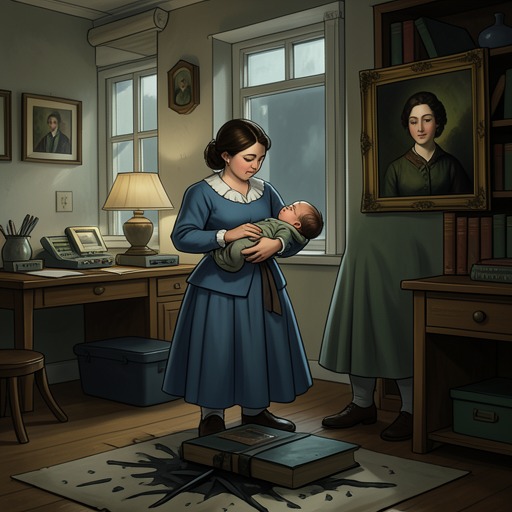
The setting makes the disease inseparable from poverty and inadequate care. The family lives in a bare room with broken windows, no fire, ragged bedclothes, a sick mother, a wailing baby, and hungry children crowded beneath one old quilt. Elizabeth takes the baby into her lap while waiting for Mrs. Hummel to return. The child seems to sleep, then cries, trembles, and becomes still. Elizabeth tries to warm its feet, while Lottchen gives it milk, but the baby does not respond. A doctor later confirms the death and identifies scarlet fever in the household, adding that Heinrich and Minna have sore throats and should have received medical attention earlier.
The episode shows both the emotional and material dimensions of infectious disease. Mrs. Hummel is poor and has attempted to cure the baby herself because professional treatment is difficult to afford. The doctor becomes kinder when he learns her circumstances, agrees to help the other children, and accepts that charity must supply his payment. Elizabeth’s compassion therefore brings her into direct contact with a disease intensified by poverty, delayed medical intervention, and overcrowded living conditions.
Infection and Medical Warning
After the baby’s death, the doctor warns Elizabeth to return home and take belladonna immediately, because she has been exposed and already shows troubling signs. Elizabeth has found information about the illness in her mother’s medical book and recognizes headache, sore throat, and strange bodily feelings as possible beginnings of the fever. She takes the medicine and tries to reassure Josephine March that she will not become seriously ill, but her attempt to manage the danger through household knowledge proves inadequate.
Elizabeth’s experience distinguishes personal courage from medical control. She does not describe the baby’s death as horrifying in itself; she calls it sad and recounts that she simply held the child gently until Mrs. Hummel returned. Yet the same calm devotion places her own body at risk. The doctor’s authority interrupts the family’s moral language of kindness with a clinical warning: exposure has consequences, and benevolence cannot by itself prevent contagion.
The illness also reveals how knowledge is distributed within the household. Elizabeth studies her mother’s book and acts on what she has read, while Josephine responds through frightened affection and self-reproach, saying that she should have gone instead. Once Elizabeth becomes ill, Hannah Mullet and the doctor control information and treatment, while the sisters remain largely ignorant of the seriousness of her condition. The family’s emotional life is therefore shaped not only by symptoms but by what caregivers know, conceal, and decide to disclose.
The Household Crisis
Elizabeth’s fever becomes far more dangerous than Hannah Mullet and the doctor initially allow the girls to understand. The narrative explicitly marks the beginning of this period as a season of dark days. Meg remains at home rather than risk infecting the Kings, keeps the household running, and feels guilty when her letters to Mrs. March omit Elizabeth’s illness because Hannah refuses to alarm the absent mother over what she calls a trifle.
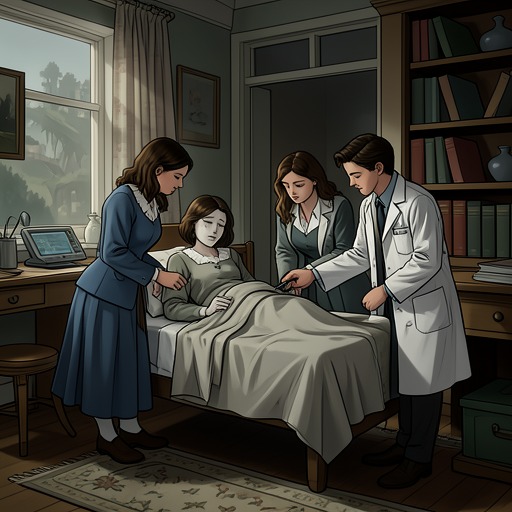
The disease reorganizes the family’s ordinary time. Josephine March never leaves Elizabeth’s side. Hannah sits up at night, Dr. Bangs visits twice each day, and Meg keeps a telegram ready in case Mrs. March must be summoned. Elizabeth, even while gravely ill, remains concerned for others: she worries about Josephine, sends loving messages to Amy Curtis March, and asks for pencil and paper so that her father will not think she has neglected him. Her concern for her cats and for Joanna also preserves the pattern of gentle attention that has defined her before the illness, even as fever progressively interrupts consciousness.
The crisis reaches its bleakest point on the first of December, amid bitter wind and falling snow. Dr. Bangs examines Elizabeth for a long time, holds her hot hand, and quietly advises Hannah that Mrs. March should be sent for if she can leave her husband. The recommendation changes the meaning of the illness from a temporary household inconvenience to a possible deathbed emergency. At the same time, Josephine hears Elizabeth speaking incoherently about the “flocks of green doves” formed by vine leaves on the wall and realizes that her sister no longer recognizes the family. Her fear is intensified because both parents are absent and she feels spiritually abandoned as well as medically helpless.
Crisis, Recovery, and Aftermath
The apparent turning point arrives when Josephine sees Elizabeth’s fever flush and pain disappear. Elizabeth’s face looks pale and peaceful, and Josephine, believing that death has come, kisses her and says, “Goodby, my Beth. Goodby!” Hannah Mullet then wakes, examines the girl’s hands and breathing, and recognizes that the fever has turned: Elizabeth is sleeping naturally, her skin is damp, and her breathing is easy. Dr. Bangs confirms that she is likely to survive if the house remains quiet and she is allowed to sleep.
Recovery does not erase the disease’s effects. During the illness, the whole neighborhood discovers how many friends the shy Elizabeth has made. The milkman, baker, grocer, butcher, and neighbors inquire about her, while Mrs. Hummel comes to apologize for her thoughtlessness and seek a shroud for Minna. James Laurence locks his grand piano because its music recalls the young neighbor who once made his twilight pleasant. The illness thus measures Elizabeth’s social importance through absence: the household and neighborhood are altered because her quiet service has connected her to people far beyond the family.
The family’s relief is also shadowed by the fragility of survival. Elizabeth later appears to recover, but when Josephine returns in the spring after an absence, she sees that her sister has become thinner and strangely transparent, as though her mortal body were gradually being refined away. Elizabeth prefers a quiet seashore visit to a distant mountain trip, and she and Josephine remain together there, the strong sister and the feeble one moving as if they instinctively know that a long separation is approaching.
Disease, Mortality, and Family Meaning
Scarlet fever changes the March family’s understanding of Elizabeth from that of a timid, dependable child to that of a person whose life may be brief and whose presence must be valued in the present. The illness forces Josephine to confront the limits of writing, ambition, and worldly plans. When Elizabeth later tells her sister that love is the only thing that can be carried beyond life, Josephine renounces her old ambition and promises to assume greater responsibility for their parents and household.
The disease therefore functions as more than a medical episode. It connects the March household to the conditions of wartime separation: Mr. March is away with the army, Mrs. March must travel because her husband is seriously ill, and the daughters are repeatedly required to transform fear into work. Mrs. March’s instruction to “Hope and keep busy” becomes especially concrete during Elizabeth’s fever, as nursing, household labor, medical observation, and communication replace helpless waiting.
Elizabeth survives the acute scarlet fever crisis, but the narrative does not present survival as a return to an unchanged life. Her later decline culminates in death during the spring, when she is guided tenderly by her parents through the Valley of the Shadow and dies quietly before dawn. The illness is consequently both an immediate danger and an early sign of mortality. It makes visible the tenderness, class vulnerability, medical uncertainty, and disciplined care that shape the March family’s response to suffering, while transforming Elizabeth’s quiet goodness into the emotional and moral center of the family’s grief.